Key Takeaways
- Pub and restaurant floors endure punishment that no domestic floor experiences — daily spillages of beer, wine, coffee and cooking oils, heavy foot traffic from morning to midnight, dragged furniture, dropped crockery and constant wet mopping create a uniquely hostile environment for timber finishes.
- Standard domestic lacquers fail within months in hospitality settings. Professional commercial finishes such as Loba 2K Supra AT, Bona Traffic HD or Myland Streetshoe NXT are specifically engineered for extreme-wear, spillage-resistant performance.
- Scheduling is everything — pubs and restaurants cannot afford extended closures. Most projects are completed during off-hours (overnight or Monday–Wednesday when footfall is lowest) or during planned refurbishment windows.
- Moisture content is a critical risk factor in hospitality environments. Kitchen adjacency, cellar proximity and constant wet cleaning can elevate timber moisture well above the 12% maximum threshold for finishing. Ignoring this causes catastrophic finish failure.
- The right finish pays for itself — a properly specified and applied commercial lacquer on a pub floor can last 8–12 years before needing a maintenance recoat, versus 6–12 months for a domestic product. The long-term cost saving is substantial.
The Problem: Why Pub and Restaurant Floors Fail So Quickly
East Barnet and the surrounding areas of North London are home to dozens of pubs, wine bars, gastropubs, cafés and restaurants — many occupying characterful premises with original timber floorboards, oak planking or reclaimed parquet. When these floors are at their best, they contribute enormously to the atmosphere: warm, authentic and inviting. When they are at their worst — scuffed, stained, sticky and delaminating — they undermine the entire dining experience.
The problem is rarely the timber itself. It is almost always the finish. Pub and restaurant owners frequently make one of two mistakes: they either apply a domestic-grade lacquer that was never designed for commercial spillage exposure, or they hire a residential floor sanding contractor who applies the right product with the wrong preparation — skipping moisture testing, omitting primer, or applying too few coats to save time.
The result is a floor that looks magnificent for three months and disastrous by six: lacquer peeling at board edges, white rings beneath every table leg, dark staining in the bar well where beer drips accumulate, and a sticky, tacky surface near the kitchen pass where cooking oils mist the finish nightly.
The Agitation: The True Cost of Getting It Wrong
A failed floor finish in a pub or restaurant is not merely an aesthetic issue — it is a commercial disaster:
- Lost revenue — re-sanding a dining room means closing that space for 3–5 days. For a busy gastropub turning over £5,000–£10,000 per week in food covers alone, the lost trading is devastating.
- Repeated cost — if the contractor gets it wrong the first time, the owner faces paying again within the year. Two failed floor jobs can cost more than one properly executed commercial restoration.
- Health and safety liability — a delaminating, peeling or sticky floor is a slip hazard. In a licensed premises, the environmental health officer can issue an improvement notice, and any customer injury on a demonstrably poorly maintained surface exposes the business to litigation.
- Brand damage — in the age of TripAdvisor, Google Reviews and Instagram, a visibly shabby floor features in photographs, reviews and social media posts. First impressions are formed in seconds, and a tired floor sets the wrong tone before the first drink is poured.
Understanding how commercial floor sanding differs from domestic work is essential. Our school hall and sports floor sanding guide covers many of the same commercial principles — large-area machinery, commercial finishes and scheduling — in a different institutional context.
The Solution: Professional Pub and Restaurant Floor Sanding
At East Barnet Floor Sanding, we have restored floors in pubs, gastropubs, wine bars, restaurants, cafés and hotel dining rooms across North London. Our hospitality floor service is built around three priorities: durability, speed and minimal disruption.
1. Site Survey and Moisture Mapping
Hospitality floors present moisture risks that domestic properties rarely do. The proximity of commercial kitchens (with constant steam, splashing and wet floors), beer cellars (cool, damp environments directly beneath the bar area), commercial dishwashers and daily wet mopping all contribute to elevated moisture content in the timber.
We map moisture content across the entire floor using a calibrated pin meter, paying particular attention to:
- Boards adjacent to kitchen thresholds and pass areas
- The bar well and beer tap zone (constant drip exposure)
- Entrance areas (rain and foot-borne moisture)
- Any areas above or adjacent to cellars
- Toilet corridor floors
Any area reading above 12% must be addressed before finishing — through improved ventilation, dehumidification, or allowing additional drying time after sanding. Applying any finish over wet timber is a guaranteed failure, regardless of product quality.
2. Commercial-Grade Sanding with Dust-Free Extraction
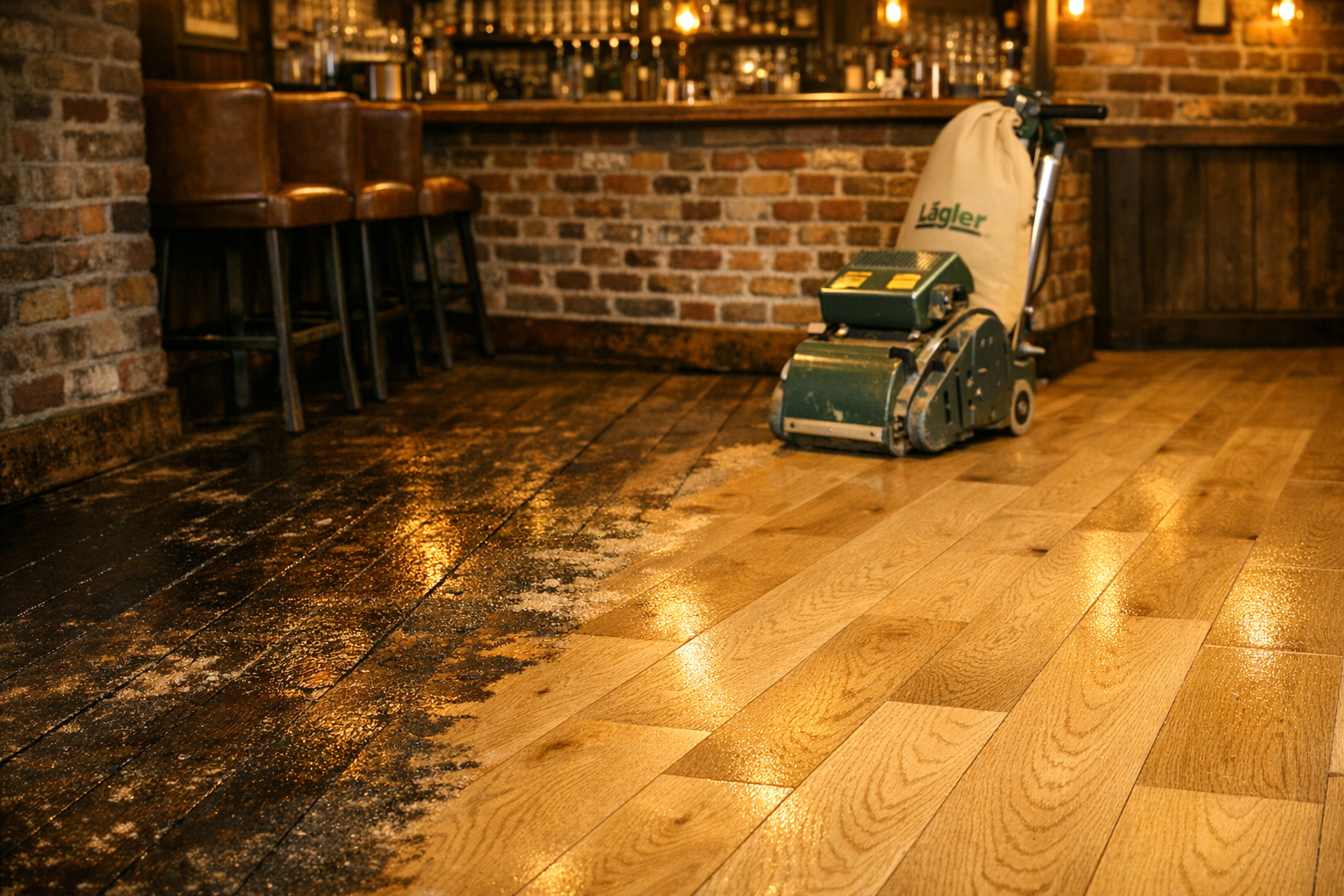
Pub and restaurant floors accumulate years of spilled drinks, cooking grease, ground-in food and cleaning chemicals. The sanding process must cut through all of this contamination to reach clean, sound timber beneath.
Our typical hospitality set-up includes:
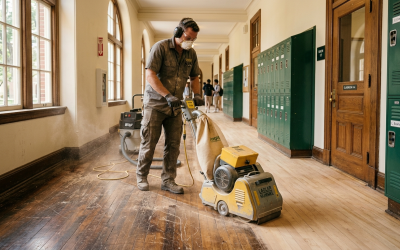
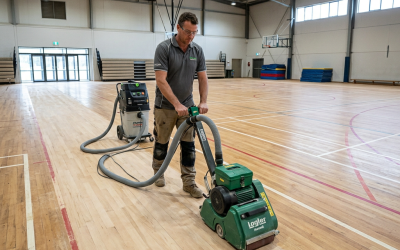
- Lagler Hummel drum sander — for rapid old-finish removal and levelling across the main dining and bar areas
- Bona FlexiSand / Frank Spider — for the refining pass that creates a uniform scratch pattern ready for commercial primer
- Bona Edge — for perimeter work under banquettes, booths and fixed bar counters
- Festool detail sanders — for corners, around bar-foot rails, beneath radiators and around fixed furniture legs
- Bona DCS 70 dust containment — capturing 99.8% of airborne dust, essential when food preparation areas are adjacent
Pro-Tip — Grit Sequence for Contaminated Pub Floors: Pub floors are often heavily contaminated with absorbed cooking oils and beer residues that penetrate the grain. We start with 40-grit Zirconia belts to cut aggressively through contaminated surface layers, then progress through 60-grit → 80-grit → 100-grit. After the 100-grit pass, we perform a solvent wipe test — dampening a small area with white spirit to check for residual contamination. If the timber still shows dark, oily patches, an additional pass at 60-grit may be needed in those zones. The final pass at 120-grit on the Frank Spider ensures a uniform surface for primer adhesion.
3. Commercial Primer and Finish Selection
This is where hospitality floor sanding diverges most significantly from domestic work. The finish must withstand not just foot traffic, but chemical assault — acids from wine and citrus, sugars from beer and soft drinks, fats from cooking oils, and the alkaline cleaning products used nightly in commercial wet-mopping routines.
Our recommended system for high-wear hospitality environments:
- Primer: Bona Prime Classic or Loba WS EasyPrime — applied by roller, dried for 2 hours, screened with 150-grit mesh
- Topcoat (2–3 coats): Loba 2K Supra AT — a two-component, water-based polyurethane lacquer specifically developed for extreme-traffic commercial environments. It offers superior chemical resistance to acids, alkalis and alcohol compared to standard commercial lacquers, a full cure time of 5 days, and is available in matt, satin and gloss finishes.
- Alternative: Bona Traffic HD — the industry benchmark for commercial durability, with a faster cure time (3 days to initial cure) but marginally less chemical resistance than Loba 2K Supra AT for heavy spillage environments.
Pro-Tip — Three Coats, Not Two: For pubs and restaurants, we always recommend three topcoats rather than the standard two. The additional coat adds approximately 15% to the material cost but extends the recoat interval by 40–50%. In a busy gastropub, this can mean the difference between re-sanding every 5 years versus every 8–10 years — a saving of thousands of pounds over a decade, plus VAT.
4. Scheduling: Minimising Lost Trading
We understand that every day of closure costs money. Our hospitality scheduling strategies include:
- Phased working — sanding the bar area Monday–Tuesday, the dining room Wednesday–Thursday, and finishing the entrance Friday morning. This allows partial trading throughout the week.
- Overnight sanding — for venues that cannot close during the week, we can sand between midnight and 8 am (subject to noise restrictions and neighbour agreements). The final coats are applied early morning and dry before the evening service.
- Planned refurbishment windows — many pubs close for 1–2 weeks annually for refurbishment. Coordinating floor sanding with kitchen refits, redecoration and furniture replacement maximises the value of the closure period.
- Fast-cure systems — in extreme time constraints, we can specify Bona Traffic HD (3-day initial cure) combined with a Bona Prime Amberseal primer that is recoatable within 1 hour, allowing two coats in a single session.
Specific Challenges by Hospitality Venue Type
Different hospitality settings present different challenges. Here is how we adapt our approach:
- Traditional pubs — heavy beer spillage, dart-board area (board damage from misses), bar-stool drag marks, cellar-trap moisture. Finish: Loba 2K Supra AT in satin, 3 coats. Focus: chemical resistance, bar-well durability.
- Gastropubs and wine bars — red wine stains (acidic, deeply penetrating), candle wax drips, designer-furniture aesthetic expectations. Finish: Bona Traffic HD in matt or satin, 3 coats. Focus: stain resistance, premium appearance.
- Restaurants — kitchen-adjacent grease migration, high-chair scuffing, table-and-chair drag. Finish: Loba 2K Supra AT or Myland Streetshoe NXT, 3 coats. Focus: grease resistance, scratch hardness.
- Cafés and coffee shops — coffee stains (tannic, persistent), high-volume foot traffic from 7 am, frequent wet mopping. Finish: Bona Traffic HD in natural/matt, 2–3 coats. Focus: ease of maintenance, natural appearance.
- Hotel bars and function rooms — formal aesthetic, high-heel traffic, cocktail spillages. Finish: Blanchon Intensiv or Bona Traffic HD in gloss/satin, 3 coats. Focus: premium sheen, maximum durability.
For businesses considering whether to sand existing floors or install new, our hardwood floor sanding guide covers the financial case for restoration over replacement in detail — the same principles apply to commercial premises.
Costs, VAT and Return on Investment
Commercial floor sanding for pubs and restaurants is quoted per project following a site survey, as variables (floor condition, access, finish specification, scheduling constraints) differ significantly. As a general guide:
- Sanding and 3 coats commercial lacquer (Loba 2K Supra AT): from £28.00 per m² (plus VAT)
- Sanding and 3 coats Bona Traffic HD: from £26.00 per m² (plus VAT)
- Deep contamination stripping (grease/oil): from £5.00 per m² (plus VAT)
- Gap filling (resin slurry): from £8.00 per m² (plus VAT)
- Board replacement (reclaimed timber): from £30.00 per linear metre (plus VAT)
For a typical pub dining area of 80 m², a full commercial restoration costs approximately £2,200–£3,000 plus VAT — an investment that protects the floor for 8–12 years with proper aftercare. Compare this with the cost of replacing the floor (£60–£100 per m² installed) or the cumulative cost of multiple failed domestic re-sands, and the commercial-grade approach is clearly the most cost-effective strategy.
For ongoing maintenance protocols that extend the life of your commercial finish, our professional aftercare guide covers recommended cleaning products, daily routines and recoat scheduling for both lacquered and oiled finishes.
Frequently Asked Questions
Can you sand the floor without us closing completely?
In most cases, yes. Phased working allows us to sand and seal one section at a time while you trade from the remaining areas. We plan the phasing with your manager to ensure the kitchen, bar and at least one dining zone remain operational throughout.
How soon can we reopen after the final coat?
With Bona Traffic HD, light foot traffic (customers walking, not dragging furniture) is possible after 24 hours. Full service, including table and chair placement, should wait 72 hours. With Loba 2K Supra AT, allow 48 hours for light traffic and 5 days for full service. We time the final coat application to maximise your trading recovery.
Will the finish cope with our nightly wet-mopping routine?
Yes — provided you use a pH-neutral wood floor cleaner (Bona Cleaner or equivalent) rather than bleach, Flash or generic multi-surface products. Alkaline cleaning products strip commercial lacquers progressively, creating dullness and adhesion failure over 12–18 months. We provide a cleaning product specification and brief your cleaning team as part of every commercial project.
Transform Your Pub or Restaurant Floor
Whether you run a traditional pub in East Barnet, a gastropub in New Barnet, a café in Cockfosters or a restaurant anywhere in North London, a professionally sanded and commercially finished floor transforms the atmosphere of your venue — and protects your investment for years. We handle everything from initial survey to final deep clean, working around your trading schedule with minimal disruption.
Contact East Barnet Floor Sanding today to arrange a free site survey and quotation. Your floor is the foundation of your customers’ experience — make it one worth remembering.