Key Takeaways
- School halls, churches and sports facilities present unique challenges — massive floor areas, tight turnaround schedules during half-terms and holidays, strict safety and slip-resistance standards, and finishes that must withstand thousands of footfalls weekly.
- Granwood composite block floors — found in thousands of UK schools built between the 1950s and 1980s — require specialist knowledge. The blocks contain wood fibre bound with resin, which behaves differently to solid timber during sanding and finishing.
- Bona Traffic HD is the industry-standard commercial lacquer for high-traffic educational and sports environments, offering exceptional durability, fast cure times and compliance with EN 14904 (indoor sports surface standards).
- Dust-free sanding with Bona DCS extraction is not optional in educational settings — it is a health-and-safety requirement to protect pupils, staff and the building’s HVAC systems.
- Sports line marking must be applied between primer and topcoat layers to ensure markings are protected beneath the lacquer, not painted on top where they wear away within months.
The Problem: Worn, Dangerous Commercial Floors in Schools and Sports Halls
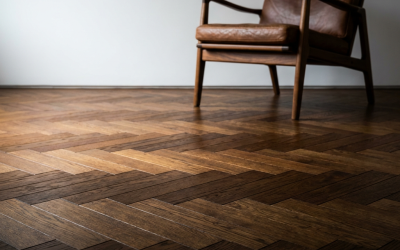
Walk into almost any state school, community hall, church hall or sports facility built in the mid-twentieth century and you will find the same floor: rows of small, rectangular composite wood blocks laid in a brickwork or herringbone pattern. These are typically Granwood floors — a proprietary composite of compressed wood fibre and thermosetting resin, designed to be hard-wearing and affordable for institutional use.
When properly maintained, Granwood and similar composite block floors last decades. But proper maintenance rarely happens. School budgets are tight. Hall floors get used for PE, assemblies, dinner service, school plays, community events, polling stations and after-school clubs — often with nothing more than an occasional mop to show for it.
The result is a floor that is scuffed, scratched, discoloured and — critically — dangerously slippery. Old polish and wax build-up creates a glassy surface that becomes treacherous when wet or dusty. Sports line markings fade, confusing play and creating officiating problems. In some cases, individual blocks loosen, creating trip hazards that can injure children.
For head teachers, facilities managers and parish councils, the question becomes: do we rip it all out and lay a synthetic surface (£40–£80 per m², plus disruption), or can the existing floor be restored? In the vast majority of cases, professional school hall floor sanding offers a dramatically better outcome — at a fraction of the cost.
The Agitation: Why Standard Floor Sanders Get It Wrong
Commercial floor sanding is not simply domestic sanding on a larger scale. The stakes are higher, the tolerances tighter, and the materials often unfamiliar to tradesmen who work primarily in residential settings. Here is what commonly goes wrong:
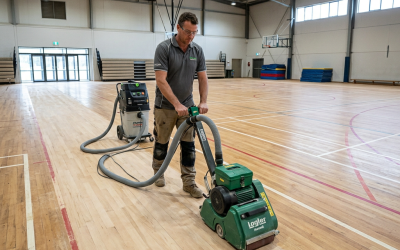
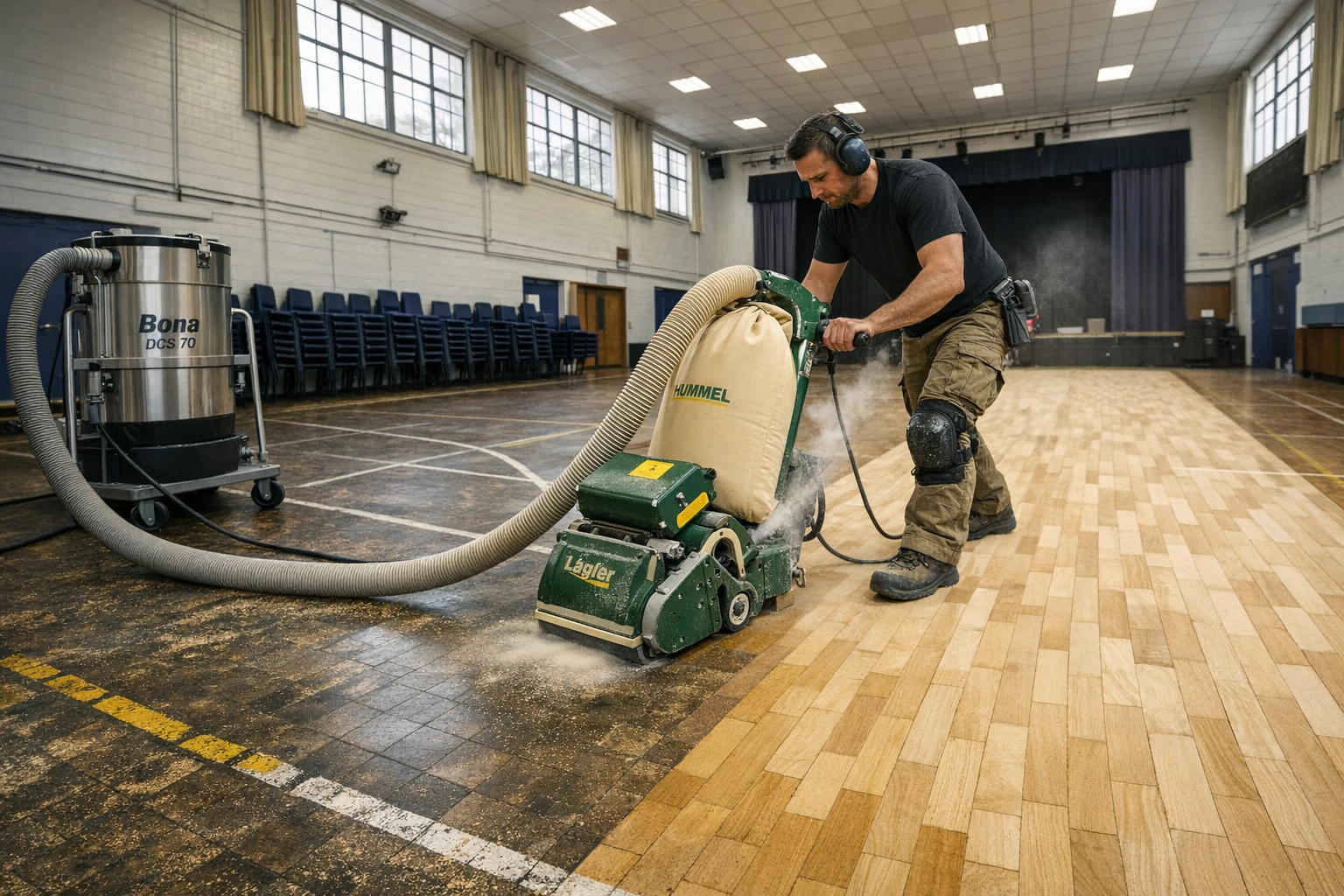
- Using residential-grade equipment on 200+ m² floors — a standard belt sander covers perhaps 15 m² per hour. A school hall of 300 m² would take days of grinding, leaving inconsistent results. Professional commercial machines — the Lagler Hummel drum sander, Frank Spider planetary machine and Bona Belt — are purpose-built for large-scale work, covering vast areas with consistent pressure and superior dust extraction.
- Applying domestic finishes — a standard polyurethane lacquer that performs adequately in a living room will fail within months in a school hall. Commercial floors need purpose-formulated products like Bona Traffic HD or Junckers HP Commercial, engineered for extreme wear, fast turnaround and compliance with slip-resistance standards.
- Ignoring Granwood’s unique properties — Granwood blocks are denser and more brittle than solid timber. They do not flex like oak or pine; they chip. Aggressive sanding with coarse grits can fracture the surface layer, creating a rough, pitted finish that traps dirt. The correct approach uses medium grits (60–80) for initial levelling, then refined passes at 100–120 before sealing.
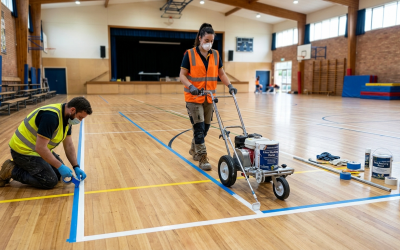
- Painting sports lines on top of the finish — this is perhaps the most common commercial error. Court markings painted over the final lacquer coat wear through within weeks, requiring constant repainting. Professionally, lines are applied between the primer/sealer coat and the topcoat, sandwiching them beneath a protective layer of lacquer that preserves them for years.
The Solution: Professional School Hall Floor Sanding — Our Process
At East Barnet Floor Sanding, we have restored floors in schools, churches, community centres, pubs, gymnasiums and sports facilities across North London, Hertfordshire and beyond. Our commercial division understands the unique demands of institutional environments — from safeguarding protocols and DBS-checked operatives to tight half-term schedules and post-works deep cleans.
1. Site Survey and Project Planning
Before any work begins, we conduct a comprehensive site survey covering:
- Floor type identification — Granwood, solid hardwood (beech, maple or oak strip), parquet blocks or engineered boards. Each requires a different approach. Our herringbone parquet sanding guide covers the specific challenges of block-pattern floors in detail.
- Condition assessment — loose blocks, moisture damage, old polish/wax layers, adhesive residue, existing line markings.
- Access and logistics — power supply capacity (commercial sanders draw 15–20 amps), vehicle access for equipment, furniture storage, and scheduling around school terms and community bookings.
- Finish specification — lacquer type, sheen level, sports line colours and layout (if applicable), and any specific requirements from Sport England or the school’s insurers.
2. Floor Preparation: Stabilisation and Repairs
Granwood blocks are typically laid over a bitumen-based adhesive on a concrete screed. Over decades, individual blocks loosen as the adhesive degrades. Before sanding, every loose block must be re-bonded using a modern flexible adhesive compatible with the original substrate. Missing or shattered blocks are replaced with matching salvaged Granwood — a material that is increasingly rare and should be sourced carefully.
Old polish, wax build-up and cleaning-product residue are chemically stripped before sanding. This is essential: waxy residues clog abrasives, contaminate the surface and prevent proper adhesion of lacquer coats.
3. Commercial-Grade Sanding: The Machine Line-Up
A school hall floor demands serious machinery. Our typical commercial set-up includes:
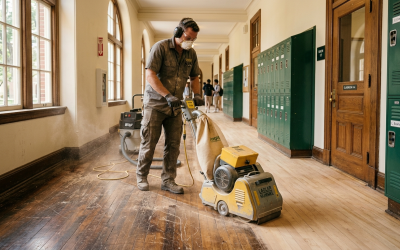
- Lagler Hummel drum sander — the workhorse for initial levelling and old-finish removal. Its wide belt and adjustable pressure system handle Granwood’s density without chipping.
- Frank Spider planetary sander — a trio-disc machine that follows the Hummel, blending belt marks and creating a uniform scratch pattern across the entire field. Essential for the flat, consistent surface that commercial lacquers demand.
- Bona Edge / Flexisand Edge — for the perimeter, under radiators and around stage platforms.
- Bona DCS 70 dust containment system — connected to all machines, capturing 99.8% of airborne dust at source. In school environments, this is a non-negotiable health-and-safety measure.
- Festool detail sanders — for corners, steps, threshold transitions and around fixed equipment.
Pro-Tip — Grit Sequence for Granwood: Unlike solid timber, Granwood responds best to a 60-grit → 80-grit → 100-grit → 120-grit sequence. Starting coarser than 60 risks fracturing the composite surface. The 120-grit finish on the Frank Spider is critical — it creates enough ‘tooth’ for the primer to key into without leaving visible scratch marks beneath the lacquer.
4. Priming, Sports Line Marking and Topcoat Application
This is the stage that defines the longevity and appearance of the finished floor. The process is strictly sequential:
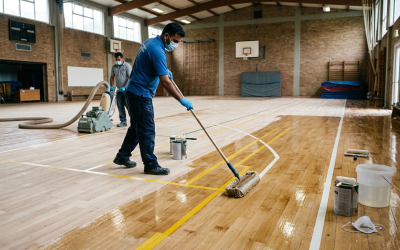
Step 1 — Primer/Sealer: A water-based sanding sealer (such as Bona Prime Classic or Bona Prime Intense) is applied by roller. This seals the surface, prevents grain raise and provides a base for the topcoat. Dry time: 1–2 hours at 20°C. Lightly screened with 150-grit mesh after drying.
Step 2 — Sports Line Marking (if applicable): Court lines are painted using specialist two-part sports marking paint in the required colours (typically white for badminton, red for basketball, blue for netball, yellow for five-a-side). Lines are applied with precision using masking tape and self-levelling applicators. This is done after the primer but before the topcoat — sandwiching the lines beneath the lacquer for maximum durability.
Step 3 — Topcoat 1: The first coat of Bona Traffic HD is applied by microfibre roller. This two-component, water-based polyurethane lacquer offers the highest wear resistance in the Bona range, with a full cure time of just 3 days — critical for schools that need the hall back in service quickly. Dry time between coats: 2–3 hours.
Step 4 — Intercoat abrasion: After the first topcoat dries, the surface is lightly screened with 180–220-grit mesh to de-nib and promote intercoat adhesion.
Step 5 — Topcoat 2 (and optionally Topcoat 3): A second coat of Bona Traffic HD is applied. For extremely high-traffic environments (sports halls used daily, church halls with weekly events), a third coat is recommended — adding perhaps 20% to the material cost but doubling the interval before the next maintenance recoat.
Pro-Tip — Bona Traffic HD Cure Times in UK Conditions: Bona Traffic HD is touch-dry in 3–4 hours but requires 3 full days to reach initial cure and 7 days for full chemical cure. During this period, the hall should not be used for PE, events or heavy foot traffic. In winter, when school halls may drop below 15°C overnight, curing slows dramatically. We recommend maintaining a minimum temperature of 18°C and 40–60% relative humidity throughout the cure period — portable heaters and dehumidifiers can be arranged if needed.
Beyond Schools: Other Commercial Floor Sanding Applications
The same professional methodology applies to a wide range of commercial and institutional settings across East Barnet and beyond:
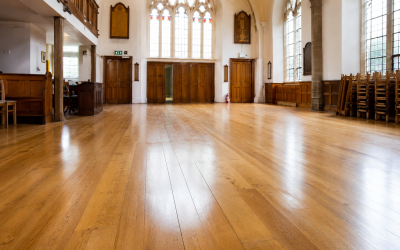
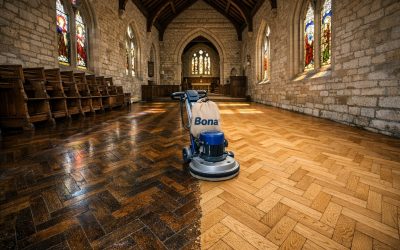
- Church and chapel floors — often original Victorian or Edwardian oak parquet, requiring heritage-sensitive restoration with sympathetic finishes. See our parquet floor restoration guide for the specific approach.
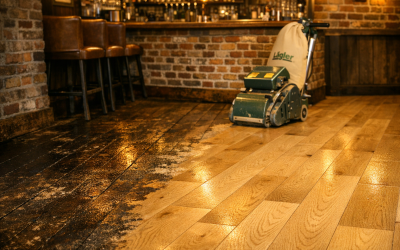
- Pub, restaurant and café floors — heavy foot traffic, spillage risk and aesthetic requirements demand durable, easy-to-maintain finishes. Bona Traffic HD in a satin or matt sheen is ideal.
- Community halls and village halls — similar challenges to school halls, often with added complications like listed-building restrictions and volunteer-run maintenance.
- College and university floors — lecture theatres, corridors and common rooms with solid timber or engineered wood benefit enormously from commercial-grade sanding and finishing.
- Gym and fitness studio floors — sprung timber sports floors (often Junckers or Haro systems) require specialist knowledge of the subfloor structure to avoid damaging the sprung battens during sanding.
Scheduling, Disruption and Costs
We understand that commercial premises cannot afford extended closures. Our team is experienced in working to tight deadlines — typically during school half-terms, Easter breaks, summer holidays or over weekends for churches and community halls.
As a guide:
- A standard school hall (150–300 m²) can typically be sanded, sealed and re-lined in 5–7 working days, depending on the condition of the floor and the number of coats specified.
- A smaller church hall or community centre (80–150 m²) may take 3–5 working days.
- All work is carried out using dust-free extraction, and a post-works deep clean of the hall is included as standard.
- Pricing for commercial projects is quoted on a per-project basis following our site survey, as the variables (floor condition, access, finish specification, line marking) differ significantly between venues.
For school bursars and facilities managers, it is worth noting that floor restoration is typically classified as building maintenance expenditure rather than capital expenditure, and may be funded from the school’s delegated maintenance budget or through a local authority bid. VAT is charged at the standard rate on commercial floor sanding services.
Frequently Asked Questions
Can Granwood floors be sanded more than once?
Yes, but with care. Granwood blocks are typically 9–12 mm thick. A professional sanding removes approximately 0.5–1 mm of material. Most Granwood floors can be sanded 3–4 times over their lifespan before reaching the adhesive layer. We assess thickness during our survey and advise accordingly.
Is the process safe for children with asthma?
Our Bona DCS dust extraction system captures 99.8% of airborne particles, and all sanding is carried out when the building is unoccupied (during holidays or weekends). Water-based finishes like Bona Traffic HD have very low VOC emissions and are certified for use in educational environments. The hall is ventilated thoroughly before pupils return.
How long do sports line markings last?
When applied between primer and topcoat (the correct method), sports lines protected beneath Bona Traffic HD last 8–12 years in a typical school environment. Lines painted on top of the finish typically last 6–12 months at best. For more on how our hardwood floor sanding approach ensures long-lasting results, explore our domestic guide which shares similar finishing principles.
Transform Your School Hall or Commercial Floor
Whether you manage a primary school in East Barnet, a church hall in New Barnet, a pub in Cockfosters or a sports facility anywhere in North London, our commercial floor sanding service delivers a floor that is safe, beautiful and built to last. We handle everything from initial survey to final deep clean — on time, on budget and with minimal disruption.
Contact East Barnet Floor Sanding today to arrange a free site survey and quotation. Let us bring your commercial floor back to its best — and keep it there for years to come.